



The Wheel of Life: Understanding the Bhavachakra
A hand-painted map of the mind — how ignorance, karma, and craving keep us turning through six realms of existence, and what the Buddha taught to step off the wheel.

What Is a Thangka?
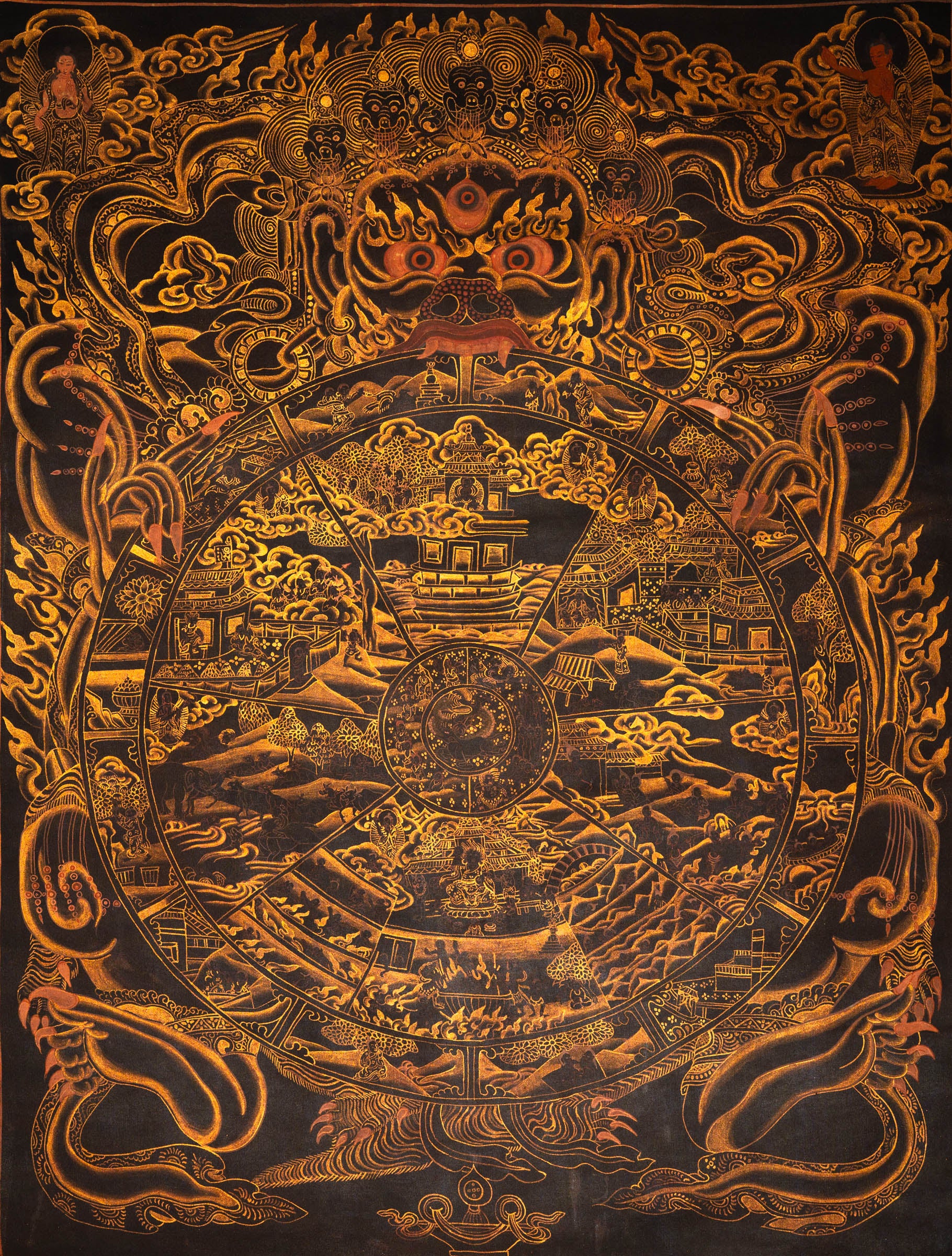
A thangka is a traditional Tibetan Buddhist painting, usually made on cotton canvas and mounted in a silk brocade frame, used as a teaching tool, meditation aid, and object of devotion. Each thangka is painted by hand, following exact iconographic proportions passed down through generations of artists, so that the image remains both spiritually accurate and visually alive. The Wheel of Life is one of the most famous subjects in Tibetan sacred art. It is painted as a thangka, and traditionally also as a wall mural in the entrance porch of a monastery, placed there so visitors would see it, and reflect on it, before stepping inside.

What Is the Wheel of Life (Bhavachakra)?
The Bhavachakra, or "Wheel of Becoming," is a symbolic map of samsara — the endless cycle of birth, death, and rebirth driven by ignorance, craving, and aversion. It illustrates the Buddha's teaching on the Four Noble Truths: that life involves suffering, that suffering has a cause, that the cause can end, and that there is a path to end it. Held in the jaws and claws of Yama, the Lord of Death, the wheel reminds the viewer that no realm of existence — however pleasant — is permanent or free from suffering, and that liberation comes only through understanding, not escape.
The Three Marks of Existence
Everything inside the wheel carries three characteristics the Buddha returned to again and again: impermanence (anitya), unsatisfactoriness (duhkha), and non-self (anatman). Nothing lasts, since every realm, body, and state of mind is passing. Nothing conditioned is finally satisfying — not because life is only pain, but because holding on to what will not hold is itself a strain. And nothing within it contains a fixed, separate self: what we call a person is a process of body, feeling, perception, habit, and awareness, changing moment to moment.
The third mark matters for reading the wheel correctly. Rebirth here is not a soul travelling from one life to the next like a traveller changing rooms; it is a stream of conditioned events continuing, the way one flame lights another. Ignorance at the hub is precisely the failure to see this, which is why the turning never stops on its own.
The Four Layers of the Wheel
Every Bhavachakra is built from four concentric layers, read from the center outward. Together they show the cause of suffering (center), how actions shape destiny (second ring), where that destiny leads (third ring), and the process that keeps it all turning (outer rim).
1. Central Hub
The three poisons — ignorance, attachment, and aversion — shown as a pig, rooster, and snake chasing one another.
2. Second Layer
Karma in motion: positive karma carrying beings upward through wholesome action, negative karma dragging them down through unwholesome action.
3. Third Layer
The six realms of rebirth — god, demi-god, human, animal, hungry ghost, and hell — each a different flavor of samsara.
4. Outer Rim
Twelve small scenes, the links of dependent origination, showing step by step how one life conditions the next.
The Central Hub: Three Poisons

At the hub of the wheel, three animals bite one another's tails in an unbroken circle — the root cause from which every other part of the wheel unfolds.
🐷 Pig — Ignorance
Represents delusion and not seeing reality as it truly is, the base poison that feeds the other two.
🐍 Snake — Aversion
Represents hatred, anger, and the impulse to push away what feels unpleasant.
🐓 Rooster — Attachment
Represents desire and craving, the constant grasping for what feels pleasant.
The Second Layer: Karma in Motion

Surrounding the hub, a narrow ring is split into two halves, showing where positive and negative actions lead.
Positive Karma
Wholesome action — generosity, discipline, patience, and wisdom — carries these figures upward at ease toward the fortunate realms.
Negative Karma
Unwholesome action — greed, hatred, and harm — drags these figures downward in chains toward the lower, more difficult realms.
Beyond Both Halves
Both halves of this ring keep the wheel turning. Wholesome action leads to a more fortunate rebirth and unwholesome action to a harder one, but a fortunate rebirth is still a rebirth — as the god realm in the next ring shows, merit eventually runs out and the falling begins again.
This is why the tradition describes a further kind of action, neither dark nor bright: action carried out without craving for what it will bring. Because nothing is grasped at, no new seed is planted, and such action leads to the ending of action itself. Good karma makes the turning gentler. Only action free of grasping brings it to rest.
The Third Layer: Six Realms

Tap a realm below to read about it.
God Realm (Deva): A world of long life, comfort, and pleasure so complete that beings forget to practice, until their good karma runs out and they fall again.
Dominant affliction: pride.
Demi-God Realm (Asura): Powerful, ambitious beings who constantly fight the gods out of envy, gaining wealth but never lasting peace.
Dominant affliction: jealousy.
Human Realm: Considered the most precious rebirth, balancing enough hardship to inspire practice and enough freedom to actually pursue it.
Dominant affliction: desire.
Animal Realm: A world governed by instinct, fear, and servitude, where beings struggle simply to survive with little chance to learn.
Dominant affliction: ignorance.
Hungry Ghost Realm (Preta): Beings with enormous hunger and pinhole throats, tormented by craving they can never satisfy.
Dominant affliction: greed.
Hell Realm: The most intense suffering, born from extreme hatred and cruelty, depicted with fire, ice, and unrelenting pain.
Dominant affliction: hatred.
A Buddha in Every Realm
In most Tibetan versions of the wheel, a buddha or bodhisattva is painted inside each of the six realms, teaching the beings who live there. However far a rebirth has fallen, no realm is shown as sealed off from awakening, and the affliction that shapes each one is the very material the teaching works with.
The six are also read a second way, as states of mind available in this life rather than only as destinations after death. Rage has the quality of the hells, addiction the quality of the hungry ghosts, envy the quality of the demi-gods, and comfortable distraction the quality of the god realm. Read this way, the wheel describes less where we go than where we already spend our days.
The Rim: Twelve Links of Dependent Origination
Running around the outer edge, twelve small scenes tell the step-by-step story of how suffering is created and re-created, life after life. Each cause gives rise to the next effect — break one link, and the whole chain loses its power. All twelve links are listed below with their traditional symbol and full meaning.
The commentarial tradition also spreads the twelve across three lives rather than one: ignorance and volitional formations belong to the life before, the links from consciousness through becoming describe the present, and birth, aging and death point to the life ahead. Read either way, the point holds — no link stands on its own.

1. Ignorance (Avidya)
The blind wanderer
Ignorance is the root that starts the entire cycle: not seeing reality clearly, misunderstanding impermanence and the true nature of self. Like a blind person feeling their way forward, a clouded mind stumbles through life reacting instead of understanding — the seed every other link grows from.

2. Volitional Formations (Samskara)
The potter shaping clay
Out of ignorance arise our volitional formations — intentions and actions of body, speech, and mind. Just as a potter shapes wet clay into a lasting form, habitual choices mold consciousness, setting the direction for the next rebirth.

3. Consciousness (Vijnana)
The restless monkey
Conditioned by those formations, bare consciousness arises, continuing from one moment — and one life — to the next. What continues is a stream of conditioned moments, not an unchanging self. A monkey leaping endlessly between branches mirrors how consciousness jumps from object to object, seeking a new place to land.

4. Name and Form (Namarupa)
Two in a boat
Consciousness needs somewhere to land — name (the mental side) and form (the physical body). Two people crossing a river in one boat depict this pairing: the boat carries its passenger forward, neither reaching the shore without the other.

5. Six Sense Bases (Ayatana)
The house with six windows
Once mind and body are established, the six sense bases develop — eye, ear, nose, tongue, body, and mind. A house built with six openings shows these doorways, ready to let the outside world flood in.

6. Contact (Sparsa)
The embrace
Through the six sense doors, contact occurs — a sense organ, its object, and consciousness meeting at once. The embrace represents this union, the spark where experience actually begins.

7. Feeling (Vedana)
Arrow in the eye
Contact gives rise to feeling — pleasure, pain, or neutrality coloring every experience. An arrow piercing the eye captures how immediate feeling is: sharp, instant, impossible to ignore.

8. Craving (Trsna)
The drinker
Feeling breeds craving — our thirst for pleasant experience to continue and unpleasant experience to end. Like someone drinking again and again chasing a feeling that never satisfies, craving always promises relief it can't deliver.

9. Grasping (Upadana)
Picking the fruit
Craving matures into grasping — actively reaching for and clinging to what we desire, whether objects, views, or a sense of self. Picking fruit shows this grabbing impulse: not content to want, we stretch out to seize.

10. Becoming (Bhava)
Pregnancy
Grasping sets in motion becoming — the process by which a new existence is conceived and readied. A pregnant figure embodies this precisely: the karmic momentum of clinging has already taken form and is developing toward its next expression, waiting to be born.

11. Birth (Jati)
Childbirth
What has been forming must eventually emerge, and birth is that arrival — not only physical birth, but the rising of any new state, identity, or moment of self. Childbirth reminds us that with every birth comes the certainty of everything that follows: growth, aging, and eventual loss.

12. Aging and Death (Jaramarana)
The funeral procession
Birth inevitably leads to aging and death, closing the circle only to begin again at ignorance. A body carried to the funeral ground represents the unavoidable end of every life — and, without awakening, the turning point back to link one, spinning the Wheel of Life onward once more.
Where the Chain Can Be Broken
The rim is not drawn as a trap without a door. Read in reverse, the twelve links are also a description of their own undoing: when ignorance ends, the formations built on it end, and everything downstream loses its footing. Two links are the traditional places to cut. Ignorance is the root, worn away slowly through insight. Craving is the one available in any ordinary moment — contact and feeling arise whether we choose them or not, but the step from feeling into craving is where a choice still exists.
The route the Buddha set out for this is the Noble Eightfold Path, the fourth of the Four Noble Truths: right view and right intention, right speech, right action and right livelihood, right effort, right mindfulness, and right concentration. Ethical conduct steadies the mind, a steady mind sees more clearly, and clear seeing loosens the grasping that keeps the rim turning. The Buddha in the corner of the thangka is not offering rescue from outside; he is pointing at what becomes possible once craving is no longer fed.
Yama, the Moon, and the Buddha
Two figures sit outside the wheel itself, framing its meaning. In the upper corners, a moon and a small figure of the Buddha appear — the Buddha stands outside the wheel entirely, pointing toward the moon as the symbol of liberation, a reminder that freedom from samsara is possible once someone has already stepped free of the cycle.
The wheel itself is clutched by Yama, the wrathful Lord of Death, a figure some sources identify as Mara — not to frighten, but to remind the viewer that impermanence holds every realm equally, and that death is the one guarantee driving the entire cycle forward.

The Buddha
Points toward the moon
Standing outside the wheel, the Buddha points toward the full moon, the symbol of Nirvana, a sign that liberation from samsara is possible once the cycle has been stepped free of.

Yama, Lord of Death
Holder of the wheel
Yama holds the Wheel of Life in his claws. He is not presented simply as evil, but as a reminder that every conditioned existence is subject to impermanence, aging, and death.

The Full Moon
Symbol of Nirvana
The full moon shown outside the wheel represents liberation, or Nirvana, the possibility of passing beyond the cycle of conditioned existence. The Buddha points toward it as a sign that freedom from samsara can be realised.
Frequently Asked Questions
What does the Wheel of Life (Bhavachakra) represent?
It represents samsara, the cycle of birth, death, and rebirth, and illustrates the Buddhist teaching on how ignorance and craving cause suffering, and how that cycle can be ended through wisdom and practice.
Who is the figure holding the wheel?
The wheel is held by Yama, the Lord of Death, symbolizing impermanence — the fact that every realm shown inside the wheel is temporary and subject to death and rebirth. Tibetan tradition usually names this figure Yama; some sources identify him as Mara instead.
What are the three poisons in Buddhism?
The three poisons are ignorance (pig), attachment (rooster), and aversion (snake) — shown biting each other's tails at the very center of the wheel as the root cause of suffering.
How many realms are in the Wheel of Life?
There are six realms: god, demi-god, human, animal, hungry ghost, and hell — each representing a different type of rebirth shaped by past karma. Some versions of the wheel show five, combining the demi-gods with the gods.
What are the twelve links of dependent origination?
They are twelve sequential causes and effects — from ignorance through aging and death — shown around the rim of the wheel, explaining step by step how one life conditions the next.
How do you break the cycle of the Wheel of Life?
Not by accumulating enough good karma, since merit leads to a more fortunate rebirth rather than to no rebirth at all. The cycle breaks where craving is no longer fed. Contact with the world produces feeling automatically, but feeling only becomes craving, grasping, and another round of becoming if it is taken up, and that is the link where a choice remains. The Buddha's practical answer was the Noble Eightfold Path — ethical conduct, mental discipline, and wisdom developed together — until ignorance, the first link, is seen through and the chain has nothing left to stand on.
Is the Bhavachakra thangka only for Buddhists?
Not at all. Many people display it simply as a beautiful piece of art or as a daily reminder to act mindfully, regardless of their own beliefs — its message about cause, effect, and impermanence resonates broadly.
Bring One Home
Each Wheel of Life thangka in our collection is hand-painted by traditional artisans, following the same proportions and symbolism described above.
Shop Wheel of Life ThangkasWritten as an educational resource on the Bhavachakra (Wheel of Life) for Himalayas Shop. The symbolism described here follows standard Tibetan Buddhist iconography and the classical presentation of dependent origination. Where traditions differ, that is noted in the text.
Leave a comment