


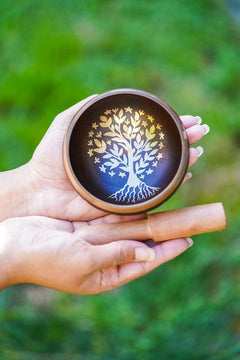

What’s in a Singing Bowl:
Singing bowls, also known as Himalayan or Tibetan singing bowls, are usually made from bronze, an alloy of mainly copper and tin. You may hear that bowls are forged from seven metals, each connected with a celestial body: lead (Saturn), iron (Mars), copper (Venus), tin (Jupiter), mercury (Mercury), silver (Moon) and gold (Sun). This is a popular legend; laboratory analyses of old and new bowls show they are mostly bronze with small traces of other metals. What really shapes a bowl’s tone, vibration and resonance is its alloy, thickness, shape and the skill of the person who made it.
How People Use Singing Bowls:
Many people use singing bowls to relax, to give their meditation a clear starting and ending point, or as part of a sound bath. When a bowl is played close to the body, its vibration can be felt as well as heard, which many people find calming and grounding. Some people also find the sound helps them unwind before sleep or during stressful periods. A singing bowl can be a lovely part of a self-care routine, but it is not a treatment for any medical or mental health condition. If you are dealing with pain, anxiety, low mood or insomnia, please speak to a health professional.
What Does the Research Say?
Research on singing bowls is still at an early stage, and only a small number of studies have been published. A 2020 systematic review (Stanhope & Weinstein, Complementary Therapies in Medicine) found few studies with a high risk of bias and concluded that more robust research is needed before firm recommendations can be made. The studies below are interesting, but they are small.
In a 2017 observational study from the University of California, San Diego (Goldsby et al., Journal of Evidence-Based Integrative Medicine), 62 adults with an average age of 49.7 took part in a 60-minute sound meditation. Singing bowls were played for about 95% of the session, alongside gongs, tingsha, bells and a didgeridoo. Afterwards, participants reported less tension, anger, fatigue and low mood, and a greater sense of spiritual well-being.
People who were new to this kind of meditation reported the largest changes, and participants aged 40 to 59 who were new to it also reported reductions in physical pain. The study had no control group, so it cannot show that the singing bowls themselves caused these changes.
A small 2014 study in the American Journal of Health Promotion (Landry) found that 12 minutes of singing-bowl sound before a guided relaxation led to a greater drop in systolic blood pressure and heart rate than silence did. Again, this was a small study, and larger, well-controlled trials are needed.
What People Experience
With those limits in mind, here is what people most often describe after playing or listening to a singing bowl.
1. In the Body
· A sense of deep relaxation
· Feeling the vibration physically when the bowl is played close by
· Slower, steadier breathing
2. In the Mind
· Better concentration during meditation
· A quieter, less busy mind
· A welcome pause from everyday stress
3. In Spiritual Practice
· A sense of balance and harmony
· A clear focus for chakra meditation, as practised in many modern traditions
· A feeling of stillness, gratitude and connection
Leave a comment